Last Updated on October 26, 2026 by teamobn
It’s 6am Monday and the site is empty
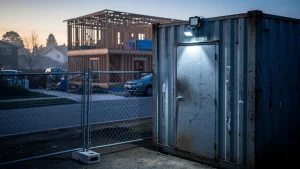
You turn up early to meet the electrician. The gate is open, the container has been levered, and the framing nailer, the drop saw and a length of copper are gone.
Nobody saw anything. There’s no footage, because there’s no power on site yet.
That’s how most site theft runs, whether the build is in Bakersfield or Ballarat. It isn’t dramatic. It’s opportunistic, and it happens over a weekend when the street is quiet and the frame is up.
This is what to put in place before the first delivery, and what to do if it goes wrong anyway. The rules and the figures differ between countries and between states, so where it matters, you’ll get both.
Why an active site is a target
An unfinished house has none of the things that protect a finished one. No residents, no sensor lights, no locked garage, and often no power.
It does have a few hundred thousand dollars of portable value sitting in the open.
The exposure grows with the number of frames going up. California contributed US$160 billion to state GDP in 2024, with more than 93,600 construction jobsites active across the state. Security firms working that market rank it among the three worst US states for jobsite theft, alongside Florida and Texas.
In Victoria, recorded offences at construction sites and premises under construction reached 4,583 in 2025, up from 4,292 the year before and 4,187 in 2023.
Measure United States Australia Scale of construction activity California: US$160 billion to state GDP in 2024, more than 93,600 active jobsites Victoria: 4,583 recorded offences at construction sites and premises under construction in 2025, up from 4,292 in 2024 How those Victorian offences split, 2025 No directly comparable published series Theft 2,720, burglary and break and enter 1,397, property damage 327, arson 18 Annual equipment theft loss US$300 million to US$1 billion (NICB and National Equipment Register, 2016 data) No equivalent national series is published, so state crime data and insurer claims are the closest proxy Recovery rate for stolen equipment 10 to 23 per cent, from the same 2016 source No reliable national figure Copper theft US Department of Energy estimate of around US$1 billion a year across US businesses Queensland network thefts up from 119 in 2020 to more than 330 in 2022 Where it concentrates Organised crews across Los Angeles, Ventura and Orange counties Sunshine Coast copper theft up 58 per cent, Moreton Bay up 31 per cent, Brisbane up 19 per cent, 2020 to 2022
Sources: Crime Statistics Agency Victoria; Associated General Contractors of California, 2025; NICB and National Equipment Register; US Department of Energy; ABC News citing Ergon Energy, Energex and Queensland Police.
A word on that US equipment figure: It’s the most quoted number in the industry, and it rests on 2016 data. The NICB and the National Equipment Register stopped publishing detailed annual equipment theft reports after that, so treat it as a floor rather than a current measurement.
The growth corridors carry the highest counts in both countries, and the reason is the same. That’s where the most frames are going up and the fewest people are home during the day.
Copper deserves its own line. In Queensland, attempted and actual copper theft from the Ergon and Energex networks went from 119 in 2020 to more than 330 in 2022. The ABC put scrap copper at about $7 a kilogram at the time, and prices have moved since.
The US Department of Energy has put copper theft at around US$1 billion a year across American businesses. Different country, different method, same incentive. It’s easy to carry and easy to sell.
If you’re building in Southern California, there’s one more difference worth knowing. Federal prosecutors have documented coordinated crews working across Los Angeles, Ventura and Orange counties.
Much of the theft elsewhere is one person with a truck and an eye for an open gate. Parts of California get organised crews instead.
Who is actually responsible for securing the site
If you’re owner-building, it lands with you. That catches a lot of people out, and it’s easier to find out now than on the morning something is missing.
The detail differs by country, so here’s the short version of both.
In Australia, engaging trades makes you the person in control of the site, and that carries work health and safety duties under your state’s WHS Act. Safe Work Australia’s construction guidance covers site access as well as hazards.
In California, the contractor licence exemption for an owner-builder only holds if none of the improvements are intended or offered for sale. For improvements to an existing home it can be used on no more than two structures in any three-year period.
For new homes you’re limited to selling four or fewer residential structures in one calendar year, and the work has to be done by licensed subcontractors.
That last condition is the one people miss. If you’re owner-building to sell, the exemption may not apply to you at all, and the Contractors State License Board is the body that decides.
Then read your contracts, wherever you’re building. A good one clearly states who secures what, who cleans up, and who is responsible for tools overnight.
Most trades carry their own tool cover and will say so. That doesn’t put their gear on you, and it doesn’t put yours on them.
If you’re building through a licensed builder or contractor, the split moves. The head contract usually puts site security on them, but the materials may still be yours to insure. Clarify that in writing before the contract is signed.
Security that changes the odds
You don’t need a guard or a monitored alarm. Victoria Police’s construction theft guidance comes down to two jobs: secure the site, and secure the tools and equipment.
Start with the things that cost almost nothing.
- Engrave or paint your driver’s licence number on every tool. Police recommend it, and it’s the one measure that turns a resale problem into evidence.
- Photograph every tool and record the make, model and serial number. Five minutes with your phone before the first delivery is worth more than any recovery attempt afterwards.
- Lock tools in a container, not in the truck. Then chain or padlock them inside the container as well.
- Pull the batteries overnight. A tool that won’t start is harder to walk out with and harder to sell.
- Keep a record of what comes and goes. A simple spreadsheet of deliveries and material movements is dull, but it settles insurance arguments.
- Ask the neighbours. A note through their doors with your mobile number gets you more eyes on the site than another camera. In Australia, police point people to Crime Stoppers on 1800 333 000 for suspicious activity.
Then the things that cost a bit more, roughly in order of what they buy you.
Light and a camera on the one access point that matters. Most site thefts come through the same gap in the fence, usually the back boundary away from the street. Cover that rather than the whole block.
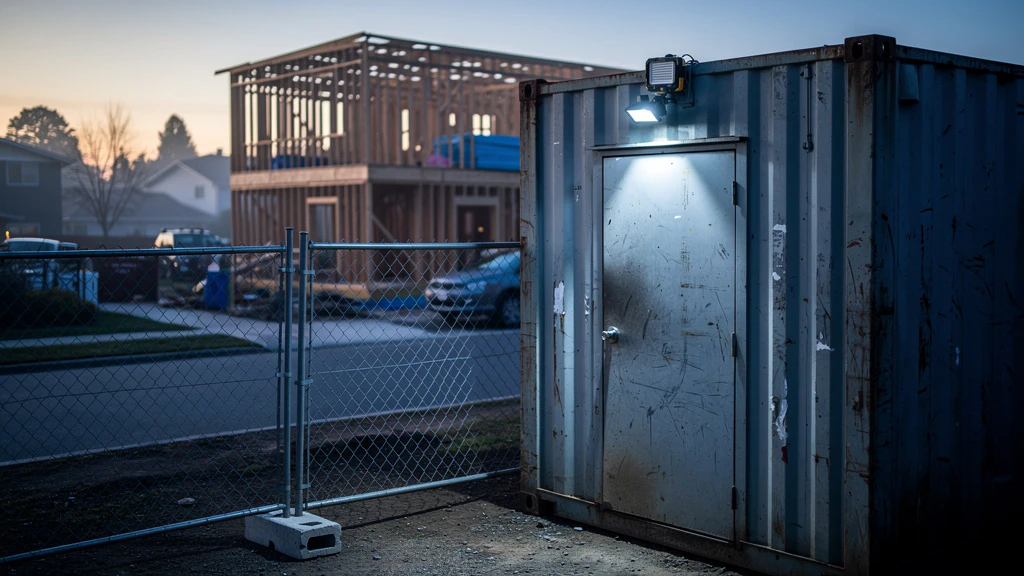
A lockable container instead of a garden shed. Steel, welded hinges, a shrouded padlock. If you’re hiring one for the build, price it against your insurance excess.
Temporary fencing that actually closes. Chain link panels are cheap to hire and they do more than mark the boundary. They also keep kids out of a hazard zone, which is a liability question before it’s a theft question.
A battery powered alarm on the container door. No wiring, no power supply, loud enough that a thief would rather not find out whether anyone’s coming.
Weather between work sessions
Weather doesn’t wait for the schedule. An exposed frame or an open roof deck turns a two-day delay into a repair bill.
Tarping properly is the cheapest insurance available, and it’s easy to do in a way that doesn’t work.
The mistake is draping plastic over an opening and hoping. A tarp that isn’t battened down will flap, and a flapping tarp shreds itself in a night. Worse, it works like sandpaper on the fresh timber underneath.
Fix it to the frame, weight the edges, and give it somewhere to shed water rather than somewhere to pool it.
A few things worth knowing before the first storm warning.
- Seal it, but let it breathe. Plastic tight enough to shed rain will trap condensation over wet framing. You can finish up with more moisture under the tarp than you’d have had without it.
- Stack timber properly. Off the ground, on bearers, with spacers between layers so air moves through. A stack sitting in a puddle is firewood by spring.
- Board up the openings you’re not working on. A sheet of structural ply on a window opening costs less than the plasterboard it protects.
- Pause a day early, not an hour late. If a system is forecast, spend the afternoon securing the site and start again the day after.
- Walk the site after every storm. Temporary fencing, roof sheeting and loose materials go first, and a sheet of iron in a neighbour’s yard is a problem you own.
Storm season timing changes with the map. In Queensland and northern NSW it runs roughly November to April. In Victoria and the ACT the hail events that do the damage cluster in the warmer months.
California runs on a different calendar again, and a different risk. The worst exposure for a frame there isn’t rain. It’s wind-driven ember and wildfire, which is part of why builder’s risk policies in the state price wildfire separately.
In warm, humid weather, mould can take hold on wet plasterboard or OSB in days rather than weeks. That’s why water damage is the expensive one, and why the tarp is worth more than it costs.
Insurance: what pays, and what voids the claim
This is the part that tends to get skipped, but it’s where most of the money sits.

In the US and Canada it’s usually builder’s risk. In Australia it’s construction works cover, sometimes sold as owner-builder insurance. Either way it covers theft, vandalism, storm and fire during the build, plus public liability.
The permit and licensing side isn’t uniform either.
- New South Wales requires an owner-builder permit for work over $10,000, with approved education requirements once the work passes $20,000.
- Queensland requires a QBCC owner-builder permit for residential work over $11,000 including GST, and the owner-builder course is compulsory unless you qualify for an exemption.
- Victoria doesn’t issue owner-builder permits. You build under a building permit, and domestic building insurance applies to contracted work over $16,000.
- California has no owner-builder permit as such, but the contractor licence exemption in Business and Professions Code 7044 has conditions, and they’re worth reading before you buy something to renovate and resell.
Check your own jurisdiction’s regulator before relying on any of that. Thresholds and course requirements change, and Victoria’s insurance arrangements shift again from 1 July 2026.
Then read the policy rather than the brochure. These are the conditions that decide whether a claim is paid.
Evidence of forcible entry. Most theft cover expects a break-in, not an open gate. An unlocked container gives an insurer room to argue negligence.
Per-item and total limits on tools. A schedule that caps tools at a few thousand dollars may not be enough to replace a full kit.
Materials cover usually starts when they land. A deposit paid on cabinetry still sitting in a supplier’s warehouse generally isn’t covered until it’s delivered.
Unoccupied period conditions. Tell your insurer if the site will sit idle over the holidays, and ask what they require while it does.
Delay costs sit outside the policy. Lost time, extra rent and alternative accommodation are separate covers and rarely included by default.
Get the sum insured right as well. It’s the cost to rebuild, not what you paid for the block.
It’s also worth doing the arithmetic before you lodge a claim. One Tasmanian building company director told The Examiner that site theft excesses had jumped 500 per cent. That’s one person’s account rather than a national figure, but the direction of travel is real.
Sometimes the excess plus the premium increase comes close to the cost of replacing the tools yourself.
The paper trail is the other aspect you need to secure
Stolen tools are an obvious risk. The quiet exposure is the paperwork that builds up around any build.
Permit portal logins. Supplier accounts. Emailed invoices, quotes and progress claims. Site photos shared with subcontractors.
All of it describes your address, your schedule, and the days your site sits empty.
The attack that actually costs people money isn’t exotic. A trade’s email address gets compromised and a fake invoice arrives with new bank details for the next progress payment. The amount is right, the logo is right – the only thing that’s changed is the account number and there’s a big chance you may not notice!
So build one rule in early. Any change of bank details gets verified by phone, on a number you already had, never the number contained in the email.
The rest is ordinary but it works.
- Unique passwords on every portal tied to the build. Not a variation on the same one.
- Two factor authentication wherever it’s offered. Especially on email, because email is the key to everything else.
- Don’t post delivery schedules publicly. “Timber arriving Friday” is a free schedule for someone else.
- Strip location data from site photos before sharing them widely. A geotagged photo of a half-finished frame tells a stranger exactly where to go.
There’s one more thing worth knowing, and it’s the narrow, useful purpose of a dark web check. It tells you whether logins or personal details tied to your email have already appeared in a breach dump. It won’t find your tools, and it won’t stop a thief.
What it does is tell you to change a password before someone uses the one you’ve been recycling since 2013. If you want to see whether your details are already circulating, you can check if your information has been exposed on the dark web before the next payment goes out.
US readers have a head start on this, in a way. California has required companies to notify residents when their data is breached since 2003, well before most other states and long before the GDPR. That’s part of why so many breach notices land in American inboxes, and why the check is worth running.
A build generates a long trail of logins and documents. Treat that trail like the site itself, and close it up at the end of the day.
When it has already happened
If you arrive to a break-in, the sequence matters more than the adrenaline.
- Don’t confront anyone. If someone is still there, get out and call the emergency number. That’s 911 in the US and Canada, 000 in Australia, 111 in New Zealand.
- Don’t touch anything. You want the scene as it was found, not tidied up.
- Report it. In Australia, the Police Assistance Line on 131 444 handles non-urgent reports. In the US, use your local police department’s non-emergency line, or the sheriff’s office if you’re outside city limits.
- Call your insurer the same day. Most policies have a notification window, and photos taken now are worth more than a description next week.
- Have the list ready. Serial numbers, photographs, purchase receipts. This is why the five minutes with your phone matters.
- Tell the neighbours and the other trades on the street. Site theft tends to be local and repeated.
There’s also a legal change worth knowing if you’re building in California. Proposition 36, which took effect on 18 December 2024, allows felony charges for repeat theft even where a single incident falls under the old US$950 threshold, and it lets prosecutors add up thefts across multiple victims and incidents.
For a builder losing a tool here and a roll of cable there, that changes what a police report is worth. Report every incident, including the small ones. A pattern is now chargeable in a way it wasn’t before.
Then document the delay. If a stolen item holds up an inspection or a pour, that’s a program problem, and your contract’s extension of time provisions are what you’ll be discussing in six weeks.
Questions owner-builders ask
Does my home insurance cover a house under construction?
Usually not. A house being built needs builder’s risk or construction works cover, which is a separate policy. Ask before the slab is poured rather than after.
If a trade’s tools get stolen from my site, who pays?
Usually the trade’s own insurance. Check the contract, and check whether your policy covers property you don’t own but control.
Can the same tools be claimed on my policy and theirs?
Generally not. Insurers won’t pay twice for one loss, so the two policies coordinate rather than stack.
Is a security camera worth it?
Often, yes. Buy it to prevent theft and treat any change to your premium as a bonus. Ask your insurer whether it affects the excess but don’t count on it.
The point of all of it
Most of what protects an owner-build costs less than a morning’s labour and takes less than an afternoon to set up. Engraved tools, a locked container, a lit access point, a tarp that’s battened down, and a phone rule about bank details.
The rest is knowing what your policy actually says before you need it.
Owner-builders rarely lose projects to the big dramatic events. More often it’s a quiet weekend and a container that wasn’t chained.
Want more? Subscribe to our weekly newsletter!
Sources
The Examiner (Tasmania), reporting on construction site theft and insurance excesses
Crime Statistics Agency Victoria, recorded offences, location groups 393 and 136, year ending December 2025
Associated General Contractors of California, California construction fact sheet, 2025
National Insurance Crime Bureau and National Equipment Register, equipment theft report, 2016 data
US Department of Energy, copper theft estimate
ABC News, “Copper thefts on the rise across Queensland as police warn electrocution is not worth the risk”, March 2023, citing Ergon Energy, Energex and Queensland Police data
Victoria Police, “Prevent construction site theft”, updated August 2025
California Business and Professions Code section 7044, and Contractors State License Board owner-builder guidance
California Department of Justice, information bulletin on Proposition 36, December 2024
NSW Government, owner-builder permit and education requirements
Queensland Building and Construction Commission, owner-builder permit and required courses
Consumer Affairs Victoria, owner-builder and domestic building insurance guidance